
I have met very few people who don’t like pasta. As you read this post, you probably have a minimum of three or four boxes of different pastas in your pantry to throw together a dinner in a pinch. And there are plenty of tasty boxed pasta recipes on notecards in your little recipe box, in cookbooks on your shelf, or online.
Fewer people have gone the extra step of making pasta from scratch. That kind of fancy stuff should be saved for the pros in a legitimate Italian restaurant, right?
Wrong!
Nothing is going to be more tasty and therapeutic for you to take up this year. It’s tasty because even bad homemade pasta is good. It can be a very forgiving process and nearly everything is fixable. And the more you do it, the more you will get a sense for how the dough should look and feel.
It’s therapeutic because it is not a rushed process. The mixing, kneading, rolling, cutting, and shaping (depending on the kind of pasta you make), is a meditative activity that uses your hands, requires some soothing slowing down of your life, and it feeds your belly. I’m convinced pasta-making will become the next practice prescribed by mental health professionals. We could all use some good mental health routines after these last couple of years.
Your first attempt at homemade pasta doesn’t even require special tools or a lot of ingredients. For this column, we are going to talk about making pasta from southern Italy, which only requires warm water, fine semolina flour (also called semola rimacinata), and salt.
Where are the eggs, you ask? None for this kind of pasta. And before you think I’m crazy, go grab a box of your dried pasta and look at the ingredients. No eggs.
This dough is most popular in southern Italy because eggs were not always available and since the wheat grown in the south is very high in protein without eggs. This durum wheat flour is the basis for the semola flour.
Once the simple ingredients are combined, the first key to good pasta is a 10-minute knead. This upper-arm workout is a necessary step to develop the unique texture for delicious handmade pasta. Stretch it, fold it against itself, press down on it, give it a quarter turn on your counter, and repeat.
You will have doubts early on about how it feels. It will first look shaggy and you may be tempted to add more water. But as you knead, the dough will start to get smoother and springy.
The second step to making good pasta is giving it a 30-minute rest covered in plastic wrap or in a plastic bag. You can let it rest even more if you put it in the fridge, just make sure it has time to come to room temperature before you work with it again. This rest relaxes the dough to the point where you can work with it again.
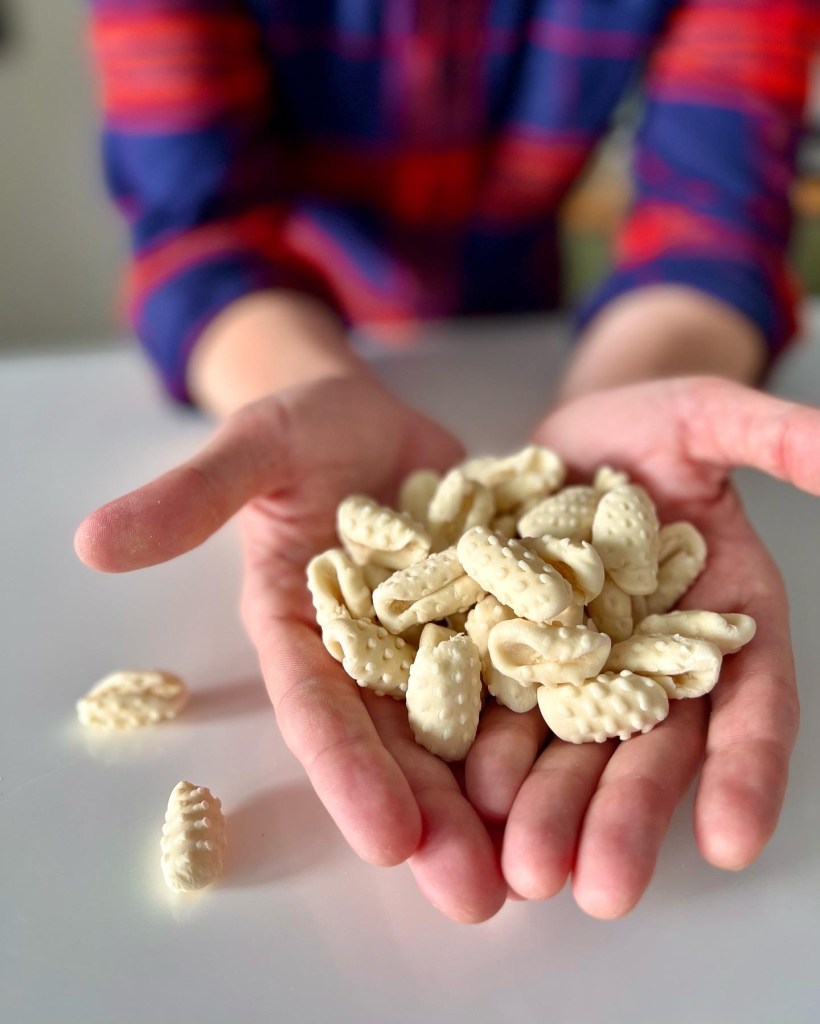
At this point, there are so many different kinds of pastas you can make with just simple utensils – orecchiette (little ears), cavatelli, pici, capunti, busiate, lorighittas, and so much more. For this column, we are going to explore malloreddus, also known as gnocchi sardi (not to be confused with potato gnocchi). They have fun little ridges and no special tools required.
MALLOREDDUS RECIPE
2 cups semola flour (fine semolina)
¾ cup of warm water
Pinch of salt
Serves 4 people
Make a large well in the flour and add the warm water and salt in the center. With a fork, make small circular motions in the water and pull in little bits of flour into the center. As you do this more, the center will become thicker. Pull in larger amounts of flour and smash it into the wetter center.
At a certain point, your hands are the better instrument going forward. Smash and roll the shaggy dough into a ball and start the kneading process as explained above for 10 minutes. It should be smooth by the end. Allow it to rest for 30 minutes in plastic wrap or sealed bag.
Cut the pasta dough into four equal portions. Keep the dough you are not using in the plastic wrap or bag so it doesn’t dry out before you work with it. Take one quarter of the dough and roll it out into a log that is ½ inch thick. Then cut pieces of dough into ½ inch wide.
Place a piece of the dough on the back of a fork, the back of a cheese grater, or on a gnocchi board. With medium pressure, use your thumb to roll the malloreddus to create small ridges on one side and an indentation where your thumb was. Repeat for all other pieces.
These should be cooked in boiling salted water for 2-3 minutes. After two minutes, bite into one to check the texture. Ideas to use cooked malloreddus include throwing them in soup, tossing them in some leftover shredded Sunday roast and gravy, mixing with marinara and topping with parmesan, tossing with browned butter and lemon juice – the possibilities are endless!
 Intermediate Chef