
“Making fresh pasta may seem to be a complicated process, but it is truly just a celebration of a few ingredients with some important steps along the way.”
A few years ago, I made it a goal of mine to learn the fundamentals of fresh pasta. That included both eggless semolina pasta and its silkier, smoother cousin – egg pasta.
You only need two ingredients for egg pasta – eggs and flour. If you are just starting out, all-purpose flour is sufficient. If you are looking to up your game, you can seek out Italian 00 (double zero) flour. It is super fine and is used to make pastas and pizza in Italy.
If you are looking for a super golden color with your egg pasta dough, find some free-range eggs. Free range chickens get a more diverse diet, and happy chickens make happy eggs.
The chickens’ diet has a lot to do with yolk color, and sometimes you can find vibrant orange yolks that make for super yellow egg pasta.
Many of the same principles I explained in my eggless pasta column a few weeks ago ring true for the egg pasta. Weighing your ingredients, especially with a super precise measurement like grams, is always going to get you a more predictable outcome versus the old way with cups and tablespoons.
The basic ratio you’ll hear everywhere is 100 gram of flour to one egg. But eggs can widely vary in size and volume, which can contribute to unintended consequences.
If you have a kitchen scale, use it because a 57% hydration is ideal (57 grams of egg for every 100 grams of flour). Otherwise, I have also provided close equivalents using cups and number of eggs. But weighing your ingredients with a kitchen scale is a step towards precision and predictability.
A good knead of your pasta dough develops a smooth, springy dough that makes for great texture. I always do a 10-minute kneading process by hand when making fresh pasta. That is followed by at least 30-minutes of a rest in plastic wrap or a sealed plastic bag.
It is possible to thin your pasta with a rolling pin, but I don’t recommend it for beginners. Getting the right thinness without drying out your dough is a balancing act that newbies shouldn’t have to focus on. I recommend buying a pasta machine.
It’s an investment for sure, and one you should not skimp on. There are cheap department store versions I’ve had to use if I’m at someone else’s house, and they really don’t work well. The very best machines are made by Imperia (like the one I grew up with) and Marcato. There are some basic versions of those brands that run between $70-$80. If you have a stand-mixer, there are also decent pasta rolling and cutting attachment for those.
EGG PASTA RECIPE
2 cups all-purpose or Italian 00 flour (240 grams)
2 full eggs and 3 egg yolks (138 grams)
Serves: 4 people
Prep time: 1 hour
Cook time: 2-3 minutes
Make a large well in the flour and add eggs and egg yolks to the center. With a fork, make small circular motions in the eggs to break the yolks and pull in little bits of flour into the center. As you do this more, the center will become thicker. Pull in larger amounts of flour and smash it into the wetter center with your fork.
At a certain point, your hands are the better instrument going forward. Smash, roll, stretch and refold the shaggy dough into a ball and start the kneading process as explained above for 10 minutes. If it seems too dry a few minutes into kneading, wet your hands and continue to knead. If it seems too wet, add more flour. It should be smooth and not sticky by the end. Allow it to rest for 30 minutes in plastic wrap or a sealed bag.
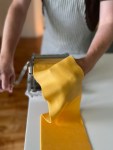
Cut the dough in half and leave one portion wrapped while you start with the other half. Smash the dough you are working with on the counter to start the thinning process before you use the pasta machine. On the pasta machines thickest settling, put the dough through. Add a little flour to the outside if you sense any stickiness. Fold the dough like French doors and run it through again. This continues the kneading process and gets you smoother dough.
I run the dough through each of the settings at least 2-3 times, refolding each time with the French door method. The thickness of your final dough depends on the kind of pasta you are making. With most machines, I rarely take it to the thinnest setting. I usually stop one step ahead, and with filled pastas I might go a bit thicker even. On your final thickness, run it through a few times without folding for a smooth dough.
Every pasta attachment has settings for a very skinny pasta that looks like spaghetti called “taglioloni” and a wider noodle that looks like fettuccine called “tagliatelle”. Or if you dust the outside with plenty of flour, you can roll up the dough and cut super wide pasta called pappardelle. I have even used this to make my own large egg noodles for lasagna. Once you get down the basics, the sky is the limit.
This pasta only take a few minutes to cook in nicely salted boiling water. You can use this with your favorite tomato sauce, chicken noodle soup, or just a simple combo of browned butter, lemon juice, and parmesan cheese.
 Intermediate Chef